
Chemical Peels in McLean and Tysons: Choosing Depth Over Brand Name
Last updated: August 25, 2026
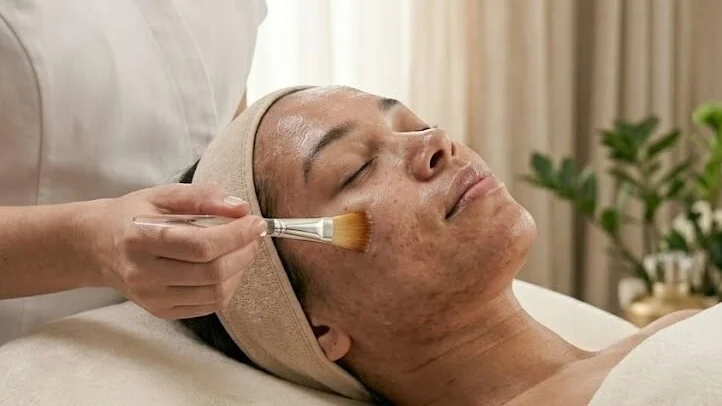
Virginia regulation permits a master esthetician to perform chemical exfoliation of the epidermis, and caps trichloroacetic acid at under 20 percent.[1][2] The brand name printed on a treatment menu tells you none of that.
Peels are classified by how deep they injure the skin, not by what they are called. A light peel works inside the epidermis. A medium peel reaches the papillary dermis and into the upper reticular dermis. A deep peel reaches the mid-reticular dermis.[3] Depth decides your result, your downtime, your risk, and who is legally allowed to hold the brush.
Two people can book “a peel” at two practices, pay similar money, and receive treatments that differ by an entire anatomical layer. The menu will not tell them. This article explains what actually decides that, using Virginia’s own rules and the clinical depth classification.
- Peels are graded by depth of penetration, not brand: epidermis, papillary into upper reticular dermis, or mid-reticular dermis.[3]
- Virginia limits a master esthetician to chemical exfoliation of the epidermis.[1]
- The regulation names the permitted agents and caps trichloroacetic acid at less than 20%.[2]
- Products used only by professionals are exempt from the federal ingredient-labeling requirement, so a salon product need not list what is in it.[4]
- The FDA recommends AHA products carry a sunburn warning covering use and a week afterwards.[5]
What Peel Depth Actually Means
Clinical literature classifies peels as light, medium or deep by the layer they injure. Light peels stay inside the epidermis. Medium peels pass through the papillary dermis into the upper reticular dermis. Deep peels reach the mid-reticular dermis. Every other difference follows from that one.
A chemical peel works by causing a controlled injury and letting the skin repair itself. How deep that injury goes is the whole variable.
The StatPearls clinical reference on chemical peels sets it out directly:[3]
“Chemical peels are commonly classified as light, medium, and deep, depending on their depth of skin penetration. Light peels induce localized injury within the epidermis… Medium peels penetrate from the epidermis through the papillary dermis into the upper reticular dermis… Deep chemical peels extend their effects into the mid-reticular dermis.”[3]
That is why downtime scales the way it does. Staying inside the epidermis means flaking and a few days of looking dry. Crossing into the dermis means real recovery, real risk of pigment change, and a treatment that deserves a medical conversation first.
Virginia Draws Its Line at the Epidermis
Virginia law defines a master esthetician as licensed for chemical exfoliation of the epidermis, using products that are not controlled substances. The administrative code then names the permitted agents outright and caps trichloroacetic acid below 20 percent.
Most states leave this vague. Virginia does not, and that is genuinely useful to you as a buyer.
The Code of Virginia defines the license this way:[1]
“‘Master esthetician’ means a licensed esthetician who… has met such additional requirements as determined by the Board to practice lymphatic drainage, chemical exfoliation with products other than Schedules II through VI controlled substances… and microdermabrasion of the epidermis.”[1]
Note two things. A standard esthetician license does not include chemical exfoliation at all. And the scope is written around the epidermis, which is exactly the layer a light peel stays inside.
The administrative code then does something unusual: it lists the actual chemicals a master esthetician may use for chemical exfoliation of the epidermis.[2]
| Permitted for a Virginia master esthetician[2] |
|---|
| Jessner and Modified Jessner solution |
| Trichloracetic acid less than 20% |
| Nonprescriptive alpha hydroxyl acids |
| Nonprescriptive beta hydroxyl acids |
| Nonprescriptive, commercially available products used in accordance with manufacturer’s written instructions |
| Vitamin-based acids, enzymes, herbal exfoliators |
Put that TCA ceiling next to the clinical concentration bands and the picture sharpens. The same reference describes very light peels as using roughly 10% to 20% TCA, light peels 20% to 30%, medium peels combinations built around 35% TCA, and deep peels TCA above 50% or phenol with croton oil.[3] Virginia’s ceiling sits at the bottom of that scale, which is consistent with a scope written around the epidermis.
Not sure which depth your skin actually needs, or who should be performing it?
Why the Brand Name Cannot Tell You the Depth
A branded peel is a formulation, and formulations come in strengths. Worse, products sold for professional use only are exempt from the federal requirement to declare ingredients, so the bottle need not tell you what is in it. The name is marketing; the concentration is the treatment.
Here is the part almost no treatment menu explains.
Federal law requires an ingredient declaration on cosmetics sold at retail. It does not require one on products used only by professionals. The FDA states this plainly:[4]
“However, because the FPLA does not apply to products used exclusively by professionals, for example, in salons, the requirement for an ingredient declaration does not apply to these products.”[4]
So you cannot read the label, because there may not be one. That single fact is why “we use [brand]” is not an answer to “how deep is this peel.”
It also cuts the other way. Jessner solution, named in Virginia’s permitted list, is a specific mixture: 14% resorcinol, 14% salicylic acid and 14% lactic acid in ethanol.[3] Knowing the formulation tells you something real. Knowing the trade name tells you almost nothing, because the same trade name may be sold in several strengths.
Ask these three questions instead of asking for a brand. Which acid and what concentration. What license the person performing it holds. Whether the intended depth stays inside the epidermis. Any practice that cannot answer all three should not be applying acid to your face.
Matching Depth to the Concern
Light peels suit acne, dullness and hyperpigmentation. Deeper work targets acne scarring, actinic damage and established wrinkles. Choosing more depth than the concern requires buys downtime and risk you did not need.
The clinical reference lists light peels as particularly effective for acne and hyperpigmentation with mild texture improvement, and medium peels as suited to hyperpigmentation, actinic keratoses, superficial acne scars and shallow wrinkles.[3]
| What you want to change | Where that usually sits |
|---|---|
| Dullness, congestion, general brightening | Light. A series beats one deep treatment |
| Active acne and oiliness | Light, typically salicylic based |
| Post-inflammatory pigmentation and melasma | Light, conservatively, with sun discipline |
| Superficial acne scarring, shallow lines | Deeper than epidermis. A medical conversation, and often better served by RF microneedling |
| Deep wrinkles, significant sun damage | Deep. Physician territory, not a spa menu item |
Deeper is not better. Deeper is more injury, and injury is only worth buying when the concern actually lives at that level. Where the goal is tone and clarity rather than resurfacing, skin rejuvenation options may reach it with less downtime.
How Long the Results Last
Durability tracks depth. A light peel refreshes the epidermis, which turns over continuously, so results are measured in weeks and are maintained with a series. Deeper resurfacing lasts longer because it remodels tissue that does not renew as quickly, and it is priced and recovered accordingly.
This is the question people actually search, and the honest answer is that it depends entirely on which of the three depths you had.
A light peel works inside the epidermis, and the epidermis renews itself continuously. That is the point of it. Results look best in the first weeks and are sustained by repeating the treatment on a schedule rather than by expecting one appointment to hold for a year.
Work that reaches the dermis lasts longer because dermal remodeling is slower to build and slower to fade. It also carries the recovery and the risk profile that go with crossing that boundary. Neither is permanent, because skin keeps aging and keeps meeting the sun.
What genuinely changes durability is what you do afterwards. Daily sun protection is not an upsell attached to the treatment; it is the variable that decides whether you keep the result you paid for.
The Sun Rule Most People Are Not Told
The FDA recommends that AHA cosmetics carry a warning that the product may increase sun sensitivity during use and for a week after stopping. That window matters in a Northern Virginia summer, and it applies to at-home acid products as much as to a treatment.
The FDA’s recommended labeling statement for cosmetics containing alpha hydroxy acids reads:[5]
“Sunburn Alert: This product contains an alpha hydroxy acid (AHA) that may increase your skin’s sensitivity to the sun and particularly the possibility of sunburn. Use a sunscreen, wear protective clothing, and limit sun exposure while using this product and for a week afterwards.”[5]
The FDA also notes that the Cosmetic Ingredient Review Expert Panel concluded glycolic and lactic acid products are safe for consumer use where the concentration is 10 percent or less, the finished product has a pH of 3.5 or greater, and the product either protects against increased sun sensitivity or instructs daily sun protection.[4]
Two practical consequences. Booking a peel the week before a beach holiday works against you. And the at-home acid serum you are already using stacks with the treatment, which is why an honest consultation asks what is in your bathroom cabinet.
What Peels Cost
The American Society of Plastic Surgeons puts the average cost of skin resurfacing procedures like chemical peels at $1,829, a figure that spans every depth from light to deep and excludes related expenses. Light peels sit far below it.
The American Society of Plastic Surgeons reports:[6]
“The average cost of skin resurfacing procedures like chemical peels is $1,829, according to the latest statistics from the American Society of Plastic Surgeons.”[6]
Read that number carefully, because it is easy to misuse. It is an average across skin resurfacing procedures spanning all three depths, and ASPS notes the price varies with the qualifications of the person performing it, the type of peel, and the geography of the office.[6] A light epidermal peel in a spa setting is a different purchase from deep resurfacing in a surgical one, and averaging them produces a figure that describes neither exactly.
The number worth asking for is the cost of the full series for the depth being recommended to you, not the price of a single appointment.
Booking a Peel Near McLean and Tysons
About Image Med Spa performs chemical peels in Oakton, a short drive from McLean, Tysons and Vienna. A consultation looks at your skin type, your pigmentation risk, what you are already using at home, and what depth the concern genuinely calls for, including when the honest answer is a lighter treatment than you came in asking for. You can see the wider range of facials and skin treatments if a peel turns out not to be the right starting point, and our guide to what a HydraFacial actually does covers the gentler end of the same shelf.
Call: (703) 944-4791
Serving Oakton, Vienna, McLean, Tysons, Fairfax, Reston, and Herndon.
Frequently Asked Questions
Tap a question to see the answer.
The Bottom Line
If you take one thing from this: stop shopping for a peel by its name. Ask which acid, at what concentration, to what depth, applied by someone holding which license. Virginia has already written down most of the answer, and a practice that treats those questions as reasonable is telling you something useful about how it works.
The right peel is usually the lightest one that addresses the concern, repeated properly, with sun protection that you actually use.
Bring what you are already using at home. It changes the recommendation more than people expect.
This article is for general educational purposes and is not medical advice. Individual results vary. About Image Med Spa is a licensed aesthetic practice. Some conditions and treatments require evaluation by a physician. Consult a licensed provider to determine whether a treatment is appropriate for you.
References
- Code of Virginia § 54.1-700. Definitions (Barbers and Cosmetologists). law.lis.virginia.gov
- Virginia Administrative Code 18VAC41-70-250. Scope of practice. law.lis.virginia.gov
- Ferreira Ferrari A, et al. Chemical Peels for Skin Resurfacing. StatPearls. National Center for Biotechnology Information. Accessed August 25, 2026. ncbi.nlm.nih.gov
- U.S. Food and Drug Administration. Alpha Hydroxy Acids. Content current as of November 22, 2022. fda.gov
- U.S. Food and Drug Administration. Guidance for Industry: Labeling for Cosmetics Containing Alpha Hydroxy Acids. fda.gov
- American Society of Plastic Surgeons. Chemical Peel Cost. Accessed August 25, 2026. plasticsurgery.org
Keep Reading
More on the treatments this article covers
 Facials and TreatmentsThe Perfect Derma Peel in Oakton: What Is Actually In It, and What a Course Costs
 Facials and TreatmentsMicroneedling vs Morpheus8: Two Different Needles, Two Different Categories
 Facials and TreatmentsLaser Toenail Fungus Treatment in Oakton: What “Temporary Increase of Clear Nail” Really Means
- Facials and TreatmentsCryoSculpting vs Morpheus8 Body in Northern Virginia: Fat or Loose Skin?
 Facials and TreatmentsCollagen Banking: Why Building Collagen Early Protects Your Skin Later
 Facials and TreatmentsPRX Treatment in Oakton: Bio-Revitalization Without Needles or Downtime
- Facials and TreatmentsHead Spa and Scalp Treatments in Fairfax for Thinning Hair and Scalp Health
- Facials and TreatmentsHow to Choose a Med Spa in Northern Virginia: What to Ask Before You Book
Latest From the Journal
- Facials and TreatmentsThe Perfect Derma Peel in Oakton: What Is Actually In It, and What a Course Costs
- Facials and TreatmentsMicroneedling vs Morpheus8: Two Different Needles, Two Different Categories
- Facials and TreatmentsLaser Toenail Fungus Treatment in Oakton: What “Temporary Increase of Clear Nail” Really Means