
How to Choose a Med Spa in Northern Virginia: What to Ask Before You Book
Last updated: August 25, 2026
“Med spa” is not a license in Virginia. Nobody inspects a business and certifies it as one. What Virginia actually regulates is each individual treatment, and it is specific about who may perform which.[1][3]
Stop evaluating the venue and start evaluating the treatment. Virginia licenses by procedure, not by signage, so the only reliable question is whether the specific person performing your specific treatment is licensed and supervised for it. Six questions below establish that in about five minutes on the phone.
After thirty years in treatment rooms I have watched this industry professionalize and I have watched it get looser at the edges at the same time. Both are true. The questions here are the ones I would ask on behalf of my own family, and each one has a Virginia statute or regulation behind it rather than an opinion.
- Virginia regulates procedures, not venues. There is no “med spa license” to verify.
- A plain esthetician license does not include chemical exfoliation; a master esthetician is limited to the epidermis.[1]
- Laser hair removal requires a properly trained person working under a physician, PA or APRN, and the regulation requires the doctor be readily available at the time of treatment.[3][4]
- That training includes a minimum of 10 proctored patient cases.[4]
- Prescription injectables may only be administered by a prescriber or someone acting under that prescriber’s direction and supervision.[5]
“Med Spa” Is a Marketing Term, Not a License
No Virginia board issues a med spa license, so the name above the door certifies nothing. Virginia instead licenses people to perform particular procedures. A business can call itself a med spa with one esthetician and no clinician, or run with full medical oversight and call itself a skin studio.
This is the misunderstanding that causes most of the bad outcomes I hear about.
People assume “medical spa” is a regulated category the way “hospital” or “pharmacy” is, and that somebody checked. Nobody checked, because there is nothing to check. Virginia licenses people to perform procedures. It does not license venues, and it does not police signage.
What follows from that is simple and freeing. You are not trying to judge a business. You are trying to establish two facts about one treatment: who will perform it, and what that person is permitted to do.
Question 1: Which License Does the Person Treating Me Hold?
Virginia separates esthetician from master esthetician, and the difference is not seniority. A plain esthetician license does not include chemical exfoliation at all. A master esthetician may perform it, limited to the epidermis and to products that are not controlled substances.
Ask for the license, not the job title. “Skin specialist,” “aesthetic technician” and “laser tech” are descriptions somebody chose. The license is a fact.
The Code of Virginia defines the senior tier this way:[1]
“‘Master esthetician’ means a licensed esthetician who… has met such additional requirements as determined by the Board to practice lymphatic drainage, chemical exfoliation with products other than Schedules II through VI controlled substances… and microdermabrasion of the epidermis.”[1]
Two consequences worth holding onto. Chemical exfoliation sits with the master esthetician and not the esthetician. And the scope is written around the epidermis, the outermost layer, which is the boundary that separates a spa treatment from a medical one.
The administrative code goes further than most states and names the permitted agents, capping trichloroacetic acid below 20 percent.[2] Our guide to choosing peel depth over brand name works through what that means when you are comparing treatment menus.
Ask us these questions. We would rather answer them than have you assume.
Question 2: Who Supervises the Medical Treatments, and Are They Here?
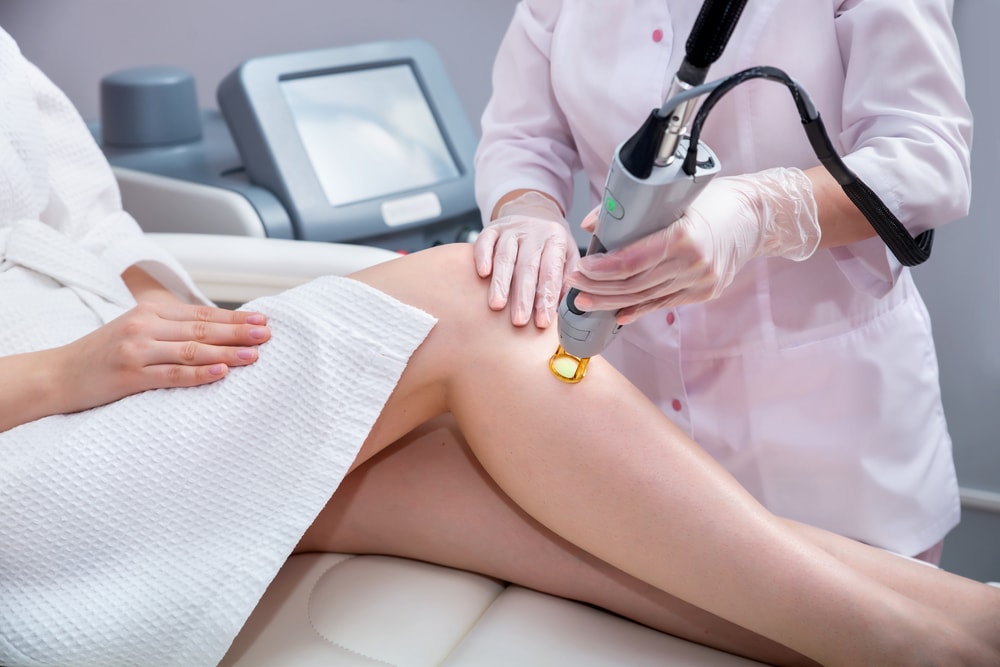
For laser hair removal Virginia requires a properly trained person working under a physician, physician assistant or advanced practice registered nurse. The regulation goes further than most people expect: the supervising doctor must be readily available at the time the treatment is performed.
This is the question that separates a serious operation from a risky one, and Virginia gives you unusually concrete language to hold a practice to.
The statute on laser hair removal permits it to be performed by a properly trained licensed physician, physician assistant or advanced practice registered nurse, or by a properly trained person under the direction and supervision of one.[3]
The Board of Medicine regulation then defines what that supervision has to look like in practice:[4]
“The doctor is readily available at the time laser hair removal is being performed.”[4]
The same regulation requires training in skin physiology and histology, patient selection, laser safety, operation of the specific device, and recognition of complications, plus a minimum of 10 proctored patient cases with demonstrated competency in treating various skin types.[4] It also requires that the supervising doctor personally see and evaluate any patient whose treatment resulted in a complication before treatment continues.[4]
So ask it plainly: who is the supervising clinician, and are they on site while I am being treated? A practice that responds only that it has a medical director has not answered the question. A name, and an arrangement for availability, is an answer.
Our guide to laser hair removal in Oakton covers what the course itself involves once you are satisfied on this point.
Question 3: What Depth Does This Treatment Work At?
Depth is the line the law is drawn around. Treatments confined to the epidermis sit inside esthetics scope. Anything intended to reach the dermis is a different category with different supervision requirements, whatever the treatment is called on the menu.
Once you notice that Virginia writes its esthetics scope around the epidermis, the right follow-up question becomes obvious.
Ask where the treatment is intended to act. A practice that can answer precisely, in anatomical terms rather than brand terms, is telling you they understand what they are selling. Our facials and skin treatments pages state the intended depth for each. A practice that answers with a product name and a number of sessions has not answered.
| What you are told | What to ask next |
|---|---|
| “It is a gentle peel” | Which acid, what concentration, and does it stay in the epidermis? |
| “It is medical grade” | Medical grade is a marketing phrase, not a regulatory one. Which license covers it? |
| “Our laser is the best on the market” | Who supervises it, and are they available while I am treated? |
| “It works below the surface” | Below which surface, and who is permitted to go there? |
Question 4: Where Did the Product Come From?
Sourcing is a real safety variable, not a paranoid question. The FDA has alerted the public that counterfeit Botox reached US clinics through an unlicensed supplier, and warned that it could not confirm the manufacture, quality, storage or handling met US standards.
People assume the product in the syringe or the bottle is whatever the label says. That assumption has failed publicly.
The FDA alerted practitioners and the public that a counterfeit version of Botox was found in the United States:[6]
“The product was sold by an unlicensed supplier who is not authorized to ship or distribute drug products in the United States. The counterfeit products are considered unsafe and should not be used. FDA cannot confirm that the manufacture, quality, storage, and handling of these suspect products follow U.S. standards.”[6]
A legitimate practice will not be offended by “where do you buy your product.” They will tell you, because the answer is a point of pride and because they know why you are asking.
Price is the tell here more often than not. A treatment priced well below every other quote you have had is usually explained by the product, the dilution, or the license of the person performing it.
Question 5: Who Administers Prescription Treatments?
Neuromodulators and fillers are prescription products. Virginia permits only a prescriber to administer them, or a nurse, physician assistant or intern acting under that prescriber’s direction and supervision. There is no route by which an unsupervised non-clinician may inject.
If injectables are on your list, this is the question that matters most.
Virginia law is direct about who may administer prescription products:[5]
“A practitioner of medicine, osteopathy, podiatry, dentistry, or veterinary medicine, a licensed advanced practice registered nurse… a licensed physician assistant… shall only prescribe, dispense, or administer controlled substances in good faith for medicinal or therapeutic purposes within the course of his professional practice.”[5]
The statute then allows a prescriber to have administration carried out by “a nurse, physician assistant, or intern under his direction and supervision.”[5] The laser statute points at the same delegation framework.[3]
The practical version of this question: is the person injecting me a prescriber, or are they working under one who is here right now? Those are the only two lawful answers.
Question 6: What Will You Tell Me Not to Buy?
The most useful signal is not what a practice recommends but what it declines to sell. A consultation that ends with every treatment on the menu being suitable for you is a sales meeting. A good one rules things out.
Everything above is verifiable. This last one is judgment, and it is the question I would weight most heavily.
Ask what they would not recommend for you, and why. If you are weighing hair removal options, that question is usually where the useful advice starts. Ask what would make you a poor candidate. Ask what they would do if you came in asking for something they thought was wrong for your skin.
A practice that offers only one technology will tend to find that one technology suitable for everybody. That is not dishonesty so much as gravity. It is why we said plainly in our comparison of electrolysis and laser that performing both is the only reason our comparison can be neutral, and why you should apply that same test to anyone advising you.
Applying These Questions to Us
A post like this is worthless if the practice publishing it expects an exemption. We do not. Ask us the same six questions, and hold the answers to the same standard you would apply anywhere else in Northern Virginia.
It would be convenient to end here with a paragraph explaining why we already satisfy all of the above. We would rather do something more useful.
Call and ask. On the phone we will tell you who will be performing your treatment and what their training is, what depth the treatment is intended to work at, and where our products come from. If a treatment you are considering falls under the supervision requirements described above, ask for the supervising clinician by name and ask whether they will be available while you are treated. Ask that here, and ask it everywhere else you are considering.
If any practice, including this one, cannot give you a straight answer to a question the Code of Virginia already answers, that is your answer. Our guide to what Morpheus8 is actually cleared for is written to the same standard.
Call: (703) 944-4791
Serving Oakton, Vienna, McLean, Tysons, Fairfax, Reston, and Herndon.
Frequently Asked Questions
Tap a question to see the answer.
The Bottom Line
Do not try to grade a med spa. There is no such license to grade. Grade the match between one treatment, one person and one scope of practice, and Virginia has already written down most of what you need to check.
Six questions, five minutes, one phone call. If the answers are specific and unhurried you have probably found somewhere good. If they are vague, or if the question seems to annoy the person answering it, you have learned something more valuable than a price.
Bring the list. We will work through it with you before anything is booked.
This article is for general educational purposes and is not medical or legal advice. It summarizes Virginia statutes and regulations current at the date of publication; verify current requirements with the relevant Virginia board. Individual results vary. About Image Med Spa is a licensed aesthetic practice. Consult a licensed provider to determine whether a treatment is appropriate for you.
References
- Code of Virginia § 54.1-700. Definitions (Barbers and Cosmetologists). law.lis.virginia.gov
- Virginia Administrative Code 18VAC41-70-250. Scope of practice. law.lis.virginia.gov
- Code of Virginia § 54.1-2973.1. Practice of laser hair removal. law.lis.virginia.gov
- Virginia Administrative Code 18VAC85-20-91. Practice and supervision of laser hair removal. law.lis.virginia.gov
- Code of Virginia § 54.1-3408. Professional use by practitioners. law.lis.virginia.gov
- U.S. Food and Drug Administration. Counterfeit Version of Botox Found in the United States. Content current as of February 26, 2018. fda.gov
Keep Reading
More on the treatments this article covers
 Facials and TreatmentsThe Perfect Derma Peel in Oakton: What Is Actually In It, and What a Course Costs
 Facials and TreatmentsMicroneedling vs Morpheus8: Two Different Needles, Two Different Categories
 Facials and TreatmentsLaser Toenail Fungus Treatment in Oakton: What “Temporary Increase of Clear Nail” Really Means
- Facials and TreatmentsCryoSculpting vs Morpheus8 Body in Northern Virginia: Fat or Loose Skin?
 Facials and TreatmentsCollagen Banking: Why Building Collagen Early Protects Your Skin Later
 Facials and TreatmentsPRX Treatment in Oakton: Bio-Revitalization Without Needles or Downtime
- Facials and TreatmentsHead Spa and Scalp Treatments in Fairfax for Thinning Hair and Scalp Health
- Facials and TreatmentsChemical Peels in McLean and Tysons: Choosing Depth Over Brand Name
Latest From the Journal
- Facials and TreatmentsThe Perfect Derma Peel in Oakton: What Is Actually In It, and What a Course Costs
- Facials and TreatmentsMicroneedling vs Morpheus8: Two Different Needles, Two Different Categories
- Facials and TreatmentsLaser Toenail Fungus Treatment in Oakton: What “Temporary Increase of Clear Nail” Really Means